Back to Site

Monday, March 30, 2015

Special Message for Child Sexual Abuse Prevention Month


April is Child Sexual Abuse Prevention Month. In honor of the children in our lives, I call upon your courage and action.Feather Berkower

First, to all of the people out there who still believe that child sexual abuse doesn’t and won’t happen in their community, I urge you to acknowledge the irrefutable facts that approximately one in three girls and one in six boys are sexually abused before the age of 18, usually by a known and trusted person in their home or community.1

Second, to the parents who still are mustering the courage to speak up to caregivers and build prevention teams, remember that adult responsibility is the cornerstone of prevention – and your kids are counting on you. Moreover, I am here for you and will support you in inviting caregivers onto your prevention teams so your kids are off limits to child sexual abusers.

Third, to the survivors who walk among us and whose lives have been forever impacted by the anguish of sexual abuse, we stand with you and pledge to prevent this crime every chance we get.

Child sexual abuse can be prevented and it starts with you.

Your Partner in Prevention,

Feather
 

1Briere, J., Eliot, D.M., 2003; Douglas, E., Finklehor, D., 2005

Monday, February 16, 2015

“No Means No – Especially When it Comes from a Child”

Meg Stone gets it right in her blog post on Huffington Post. When you teach your child that it’s okay to say “No” around physical touch you are helping to keep your child safe from sexual abuse and also paving the way for healthy sexual development.

Manners are great, but not when they compromise a child’s safety. Read "No Means No – Especially When It Comes from a Child."


Sunday, January 18, 2015

Parenting Safe Children Honors Martin Luther King, Jr.

Dr. Martin Luther King Jr. once said, "Life's most persistent and urgent question is: 'What are you doing for others?'" Today we honor his life and legacy with a call to community service because our most pressing public health issues and national problems can only be addressed by bridging racial, economic, religious, and cultural divisions--and coming together from a place of humaneness and compassion. Likewise, we must step outside of our comfort zones and have the courage of both conviction and expression.

Child sexual abuse is a national problem and public health issue. It effects not just the well-being of the survivor, but also the health of the family, the community, and even the offender. We need to concurrently lessen the number of children who are abused and the number of offenders. Tackling a public health issue starts with education, but a public health matter of this magnitude (one in three girls and one in six boys) doesn't end until every last person has dedicated him and herself to speaking up for children.

When I ask parents if they have the right to discuss with school administration and staff what child sexual abuse prevention policies are in place to keep kids safe, parents give a resounding "Yes." And then I ask, "Are YOU asking?" and the answer is an equally resounding, "No." When I ask parents if it makes sense to invite other parents or caregivers onto the family's prevention team, the parent says, "Of course," but when I ask how it's going, the parent often reports that it's too awkward or socially scary.

I appreciate your honesty, but we have to do better.

As you reflect today on community and service, please invite a member of your community onto your prevention team. And remember: Your child is counting on you to speak up.

Monday, December 15, 2014

Tips for Talking about Prevention over the Holidays

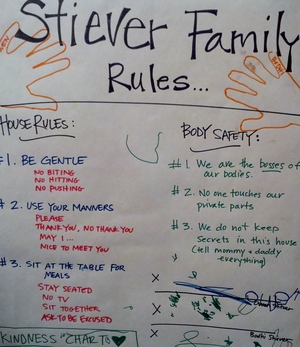
It’s the holiday season. Let’s talk prevention! Here are three specific suggestions for making child sexual abuse prevention a conversation topic with friends and family during your holiday.Body-Safety Rules Poster
  • Invite friends and family into a conversation about keeping kids safe from child sexual abuse. Each person has his or her own communication style, but here are a couple of ice-breakers to consider:
    • Let people know you went to a Parenting Safe Children workshop and why you’ve decided to invite all of the adults in your child’s life onto your prevention team.
    • Hang your body safety-rules poster in a prominent location, like the Stiever Family poster to the right, and let your family members and friends know about the rules and why they are important.
    • Consider giving a friend or family member Off Limits: A Parent’s Guide to Keeping Kids Safe from Sexual Abuse, with a personal inscription about why it’s important to you.
    • Bring up body safety just as you would any other safety topic – e.g. “I’m so glad you got a car seat with all those safety components. Can I tell you about our latest safety measure?”
You probably have other ideas for, and success stories about, inviting people onto your prevention team. Please share them on Facebook so we can all learn together.
  • As children go off to play, remind both the children and the adults about your family’s four body-safety practices:
    • Everyone plays with their clothes on.
    • No one touches private parts.
    • We don’t keep secrets.
    • If you feel unsafe in any way, come tell a trusted adult.
By communicating these safety practices in front of other adults, you are modeling prevention and opening the door for conversation.
  • The holidays are a time of greetings and affection, so it’s particularly important to remember that children and teens are safer when they get to choose when and with whom to show affection. If a family member or friend wants to greet your child with a hug or kiss, and your child does not want to, then you are being presented with a wonderful teachable moment and an opportunity to stand up for your child.
Grandma: “Oh, it’s so good to see you. Give grandma a hug.”
Mom or Dad: “I know you’re a hugger Mom, but we’ve taught Ben that he gets to choose when he shows affection and it looks like he doesn’t want to hug right now.”

Monday, December 1, 2014

The Courage to Speak Up for Kids

Parents frequently tell me how hard it is to talk with other adults about body safety and prevention, yet speaking up IS the foundation for keeping kids safe from sexual abuse. Genevieve, a Colorado mom, offers these words of encouragement:
“When I attended Feather’s Parenting Safe Children workshop, the idea of screening caregivers, coaches, teachers, etc. around sexual abuse was very intimidating. My husband and I promised ourselves, however, that no matter how uncomfortable it was, we were going to talk with everyone about our daughter’s body safety.

The first time I screened a provider I was very anxious. My heart was pounding and I was on the verge of tears because I was so scared that the person was going to look at me like I had two heads and treat me like I was a ‘problem.’

I’m happy to say, this was not at all the case. While I was told in one instance that I was the first parent to ask these questions, the provider was appreciative and thorough. This made me feel safe about leaving my daughter with her.

Next I hired two babysitters. I had gained confidence by this point. The two babysitters who I hired, and still work with today, were extremely professional during my screening process (I used the Parenting Safe Children Nanny Packet) including criminal background checks, thorough reference checks, an interview and trial meeting with my daughter, a discussion about body safety, and a babysitting contract that included body safety.”
To all the parents out there who feel the way I did, it gets easier and it feels really good to know that I have spoken up for my child in this way.”
On behalf of Parenting Safe Children, thank you to all of the parents and professionals who are speaking up for children. As you’ve probably heard me ask, “Are you willing to feel uncomfortable so kids don’t have to?”

Tuesday, November 25, 2014

Building an Off-Limits School

As you’ve heard me say before, if you ask just one question of your child’s school, day care, sports program or place of faith, ask “What policies are in place to prevent child sexual abuse?” But don’t stop there: Ask to see the policies and also inquire about monitoring.

Courtesy of Treasureland Preschool, here is one example of what a Staff Handbook ought to include. At this pre-school, staff must sign off on the policies annually and attend a workshop. Parents also receive a copy.

  1. Treasureland Preschool adheres to a “no secrets” rule. Staff members should never ask children to keep a secret from any person. 
  2. Treasureland staff respect toilet-trained children’s privacy regarding toileting but monitor the bathroom area to prevent inappropriate touching of one child by another child.
    • Diaper changing is conducted in open areas in the classrooms.
    • During toileting/diapering, adults will use anatomically correct terminology.
  3. Treasureland staff is trained on appropriate and inappropriate touching of children.
Appropriate Touch
  • Child initiates hug/side hugs
  • High fives/fist bumps
  • Holding hands when appropriate (walking uneven ground, crossing street)
  • Comforting a child when hurt or upset
  • Physical contact should always occur in public, never in private
Inappropriate Touch 
  • Requesting or pressuring children to give hugs
  • Kissing children
  • Sitting children on an adult’s lap
  • Tickling
  • Patting buttocks, massaging shoulders/backs
  • Rubbing legs
  • Repeatedly brushing against a child’s body
Thank you to Treasureland Preschool in Denver and all of the organizations that are taking the time to implement policies, train staff, and monitor practices that keep children safe from sexual abuse.

Sunday, October 19, 2014

Five Halloween Safety Tips

As you gear up for Halloween, remember that child sexual abuse is usually committed by someone the child knows and trusts – not by a stranger. Thus Halloween is yet another opportunity to invite other parents and caregivers onto your prevention team and a good time to reinforce your child’s body-safety rules.

Here are five quick tips:

Halloween Tips
  1. For older kids, find out exactly with whom they are going out trick-or-treating and stay in close communication via text or voice, with an agreed upon arrival time back home.
  2. If your child is going to a Halloween party, find out who is supervising, and discuss your child’s body-safety rules with those adults.
  3. Accompany younger children and children of mixed ages on the trick-or-treat route. Walk younger children to the door.
  4. Review your child’s body-safety rules.
  5. Remind children that you are available to come pick up them up and that you will never be mad if your child breaks a body-safety rule.
Have a fun safe Halloween!