Back to Site
Showing posts with label Parenting Safe Children workshops. Show all posts

Monday, June 6, 2016

Bathroom Panic

I’ve been asked many questions about transgender men and women using bathrooms and parental concerns about sexual abuse. The questions themselves sometime imply that transgender people are more likely to abuse and this reminds me of a similar myth that is still perpetuated about Gay men.

Fact Check: Gender identity and same sexual orientation are not predictors of child sexual abuse. The vast majority of child sexual abusers are heterosexual males.

North Carolina’s House Bill 2 and similar legislation ban people from using public bathrooms that do not correspond with the sex listed on their birth certificate. Proponents of such legislation argue that it’s important because a transgender person, or someone posing as transgender, might otherwise enter a women’s restroom and attack a young girl.

Fact Check: There are hundreds of nondiscrimination measures in place across the United States, and according to law enforcement officials, there has not been a surge in bathroom victimizations.

Unbeknownst, you and your children have been sharing public bathrooms with transgender men and women long before North Carolina passed House Bill 2 and well before Target announced a policy allowing transgender people to use the restroom of their choice. We didn’t worry it about it then and we shouldn’t worry now.

Fact Check: Child sexual abuse typically takes place in homes, youth organizations, schools, camps, and places of faith – not typically in public bathrooms.

“Stranger danger” is among a parent’s worst fear and such occurrences garner a great deal of media attention because they are brazen and sometimes horrific, but in day-to-day reality, people who sexually abuse children typically “groom” children and teens over days, weeks, and months. The abuser is not just alone with the child, but has authority over the child and takes advantage of the child’s trust.

Fact Check: 90-93% of child sexual abuse is committed by someone the child knows and trusts, who is already in their life – not by strangers.
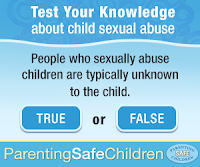

Parenting Safe Children
Test Your Knowledge
This statistic may not feel entirely reassuring because it means that 7-10% of abuse is committed by someone the child does not know, but this is not necessarily in a bathroom.

Female survivors are speaking up as well and a few have shared in the press that it would be traumatic to find a person with male genitals in the bathroom. My heart goes out to every survivor healing from sexual assault. It may be helpful to know that most gender neutral bathrooms, particularly at this point, are single-stall bathrooms – often labeled “Family Restroom” –  so anyone using that bathroom is alone anyway.

In the absence of facts, I believe that people are contributing to a climate of discrimination that hurts transgender people – and does nothing to keep children safe from sexual abuse. In fact, discrimination not only hurts the group whom it targets, but in this case it’s a dangerous distraction. I urge people to redirect their focus to meaningful ways of keeping children safe.

  1. Educate yourself about grooming behaviors so you can spot behaviors of concern.
  2. Teach children the difference between secrets and surprises. A secret is something that someone asks you “never” to tell and makes you feel uncomfortable. A surprise is something that makes you feel good and will come out into the open like a gift or a party.
  3. Maintain a “No secrets” policy in your home. Let your kids know that you don’t have secrets, only surprises. Instead of saying, “Don’t tell Mom I let you stay up tonight or we’ll both get into trouble,” you might say, "I'll let you stay up late tonight and if Mom and I disagree about bedtime, we'll work it out. It's not your problem."
    Parenting Safe Children
  4. Discuss boundaries around touch with all of your child’s caregivers, including family members, coaches, teachers, and faith leaders, and let caregivers know that your child does not keep secrets and has permission to tell you everything.
  5. Let adults know that your child has permission to say “No” if he or she ever feels unsafe.
Parenting Safe Children stands in unison with 250 national, state and local organizations, that work to prevent child sexual abuse or work with sexual assault and domestic violence survivors, in supporting equal bathroom access for transgender people.

Wednesday, May 11, 2016

PSC Launches Parenting Safe Children ONLINE Workshop


I am thrilled to announce the Parenting Safe Children Online Workshop, so parents and families across the United States and overseas have access to my popular program for raising children with strong body pride and for building communities that are off limits to child sexual abuse.

The New Online Workshop
Based on the Parenting Safe Children Workshop, which I’ve delivered live to thousands of parents, the Parenting Safe Children Online Workshop, focuses on these essential parenting skills:

    https://www.youtube.com/watch?v=fS-kZANiKgY&feature=youtu.be
  1. Teaching children about boundaries, privacy, and saying “No” to unwanted touch.
  2. Learning the difference between age-appropriate sexual behavior and problematic sexual behavior.Identifying when a child, teen or adult may be harming a child sexually.
  3. Teaching children about body pride through body-safety rules, teachable moments, and “What-If” games.
  4. Asking daycare, schools, youth organizations, and places of faith about key policies for keeping children safe from sexual abuse.
  5. Building confidence for talking about body safety with caregivers: Day care providers, teachers, babysitters, coaches, religious leaders, and members of your own family.
Pricing and Content
For an introductory $39.99, anyone outside of the Denver metro area can gain instant access to the Parenting Safe Children curriculum, which includes:

    https://www.youtube.com/watch?v=9_XaP5Yg-DQ&feature=youtu.be
  • Three modules of learning from Parenting Safe Children founder and national child sexual abuse prevention expert, Feather Berkower, divided into short segments for easy access and retention.
  • Transformative videos, reading materials, and activities, available any time, day or night.
  • Ten-page download to support parents in applying body-safety concepts in their home and community.
Call to Action
With the Parenting Safe Children Online Workshop, we can reach parents, loved ones, and caregivers throughout the United States, and around the world like never before. This is a great day for parents and kids, so please join me in my mission of keeping kids safe by

  1. Registering today for the Parenting Safe Children Online Workshop, to which you’ll have 60-day access (from the date of purchase).
  2. Sharing this blog post and link with your friends and family so they can become part of your prevention team.
Accessing the course is easy:
  • Register at http://parentingsafechildren.com/index.php/online-workshop
  • Pay via PayPal or a credit card – Be sure to enter your discount code OFFLIMITS on this screen to get the course for $39.99 (regularly $44.99).
  • Begin the workshop, which you have 60 days to complete, from the date of purchase.

Thank you for all you do to keep children safe from sexual abuse!

Sunday, May 17, 2015

Speaking With Your Pediatrician

by a Colorado Mom

I took my eight-year-old daughter to the doctor because she was having some irritation around her vagina. I talked with her ahead of time and said that the doctor may need to look at her vagina. I repeated, as I have in the past, that it's okay because I'll be with her and it's a doctor whose job is to keep her safe and healthy.

So we went into the exam and before she was examined I said to the doctor, “We have been talking about body safety and body safety rules. I have told my daughter that it's okay for you to examine her because I am here and you are helping to keep her safe and healthy.” The doctor said, "Alright, is it okay if I look at your vagina?” My daughter said “yes."

It was a short exam, and it looks like she has some irritation because of bubble bath. It was not uncomfortable and I felt like I had the confidence and language to speak up because of the Parenting Safe Children workshop. I think my daughter also felt more comfortable because I was so open and matter of fact, and because of the conversation I had with the doctor where I asserted a body-safety rule.

Monday, April 27, 2015

How I Stopped a Man Who Was Grooming

By Melina Stock, Chicago Mom

Years before I had my own son, I was working as a nanny for a family who had three young daughters. During that time, it was discovered that a classmate of their eldest daughter, Bea, (name changed to protect her anonymity) was being sexually abused by a family member. Bea’s parents and I participated in Feather's Parenting Safe Children workshop to ensure that we would be able to identify concerning behaviors in the future.

Bea's family hosted community gatherings every week. The nature of the community gatherings was such that new people were showing up on a regular basis. Some attendees came only a few times, while others stayed for months or even the entire two years that the gatherings took place.

At one point during this time frame, a young man named began to attend. I don't recall his exact age, but he was in his early 20's. I do recall getting a very strong feeling that I needed to keep an eye on him.


Soon after this man started attending the gatherings, I began to notice a pattern of behavior that represents what we call "Grooming." He rarely interacted with the adults, including me, even though I attempted to ask him questions about where he lived, what he did for a living, where he was from, how he heard of the gatherings, etc.

He began to spend the majority of his time interacting with Bea, who was seven, drawing silly pictures with her, showing her that he knew how to juggle, telling her jokes. I quietly supervised their interactions, knowing that Bea's parents were much too busy with the other guests at the gathering to take notice of his behavior. Eventually, he started to interact with Bea on the fringes, just outside of the spaces where the rest of the group was located. I also started noticing he was encouraging Bea to follow him to places even further away, saying things like, "Hey, let me show you something cool!"


My instincts – combined with concrete knowledge from the Parenting Safe Children workshop – were telling me loud and clear that this was not a safe situation. I believe that this young man was systematically taking advantage of Bea's parents' distraction, Bea's growing trust in and admiration of him, and the very large and spread-out layout of the property on which the gatherings took place. What he didn't know was that a member of the Family’s Prevention Team – ME! – was not only knowledgeable about the warnings signs, but was paying close attention.

To this day, we will never know for certain whether this man was intending to abuse Bea, because I told her parents about what I witnessed, and they watched him at one gathering and agreed that his behavior was inappropriate. Subsequently, Bea's parents talked to him about their concerns and told him he was no longer welcome to attend. We never saw him again. To me, it doesn't matter whether I was right or wrong about him, because offending him was not our concern. Protecting Bea, and the other children around was.

This story speaks volumes to the importance of inviting friends and caregivers onto your Prevention Team, because it is possible that Bea's parents, while educated about child sexual abuse prevention, were too busy to catch the subtle behaviors that were taking place. The fact is that protecting children does NOT require "Helicopter Parenting," but instead the development of a community of informed adults who can be the eyes and ears looking for these signs and behaviors, and will ultimately enable us keep all of our children safe.

Thursday, August 22, 2013

How is Your Child's School Reducing the Risk of Child Sexual Abuse?

Talking with the Director

Parenting Safe Children
Just as you would talk with the director about curriculum, teachers, meals, and play safety, it's also important to ask about policies and practices that will help to keep your kids safe from sexual abuse. There have been far too many cases of sexual abuse in schools, to let this topic, however uncomfortable, be overlooked.

Ask the director about background checks for teachers, staff and even volunteers. Most sex offenders, however, are never actually caught so they don’t end up on the National Sex Offender Registry. This means it’s also important to ask about reference checking and interviewing. Ideally, the director includes interview questions about the appropriate and inappropriate touch of children.

Also ask about a range of policies:
1)    Adults spending alone time with children
2)    Appropriate and inappropriate touch of children by adults
3)    Appropriate and inappropriate touch of children by other children
4)    Diapering, toileting, and changing clothes

Policies, however, aren’t enough, so you might ask how practices are monitored. As you are talking with the director, look for open and forthcoming communication.


Touring the School

As you walk through the school, look at the physical layout and make sure there are no spaces where an adult could be alone with a child. All of the spaces where children study, play, and interact should be open and easily visible. Doors should have windows and bathrooms should not contain areas where children can be isolated. In preschool environments, pay close attention to diaper changing areas.

Meeting the Teacher

If you don’t have a chance to meet your child’s teacher before the first day of school, it's never too late to have a conversation with him or her about your child’s body-safety rules. For example:

“I wanted to tell you that we have been teaching our son, Jamie, some body-safety rules. Perhaps you have heard him exclaim that he is the boss of his body! I also wanted to let you know that our son does not keep secrets. While we will encourage him to follow your safety rules, we have also told him that that if anyone asks him to do something that breaks one of his body-safety rules, he has permission to say ‘No’ and tell us right away.”


Training for Teachers, Staff, Parents & Children

The strongest child abuse prevention programs include regular education. At a minimum, look for annual staff training that covers myths and facts about sexual abuse, school policies, appropriate and inappropriate touch of children, and the warning signs that someone is abusing or being abused.

(This article by Feather Berkower originally appeared in Dr. Greene. Dr. Greene uses information technology to make pediatric wisdom more accessible.)


Sunday, March 31, 2013

How to Prevent Child Sexual Abuse - Infographic

April is Child Abuse Prevention month, and this How to Prevent Child Sexual Abuse infographic from Parenting Safe Children shows you how to keep your children safe from sexual abuse. It debunks common myths, offers “must teach” body-safety rules, and gives you specific questions for screening caregivers. Do your child a favor and check it out!


How to Prevent Child Sexual Abuse
 
How to Prevent Child Sexual Abuse by www.parentingsafechildren.com

Click to purchase book